
Deep framing: key aspects of mouldings with relief
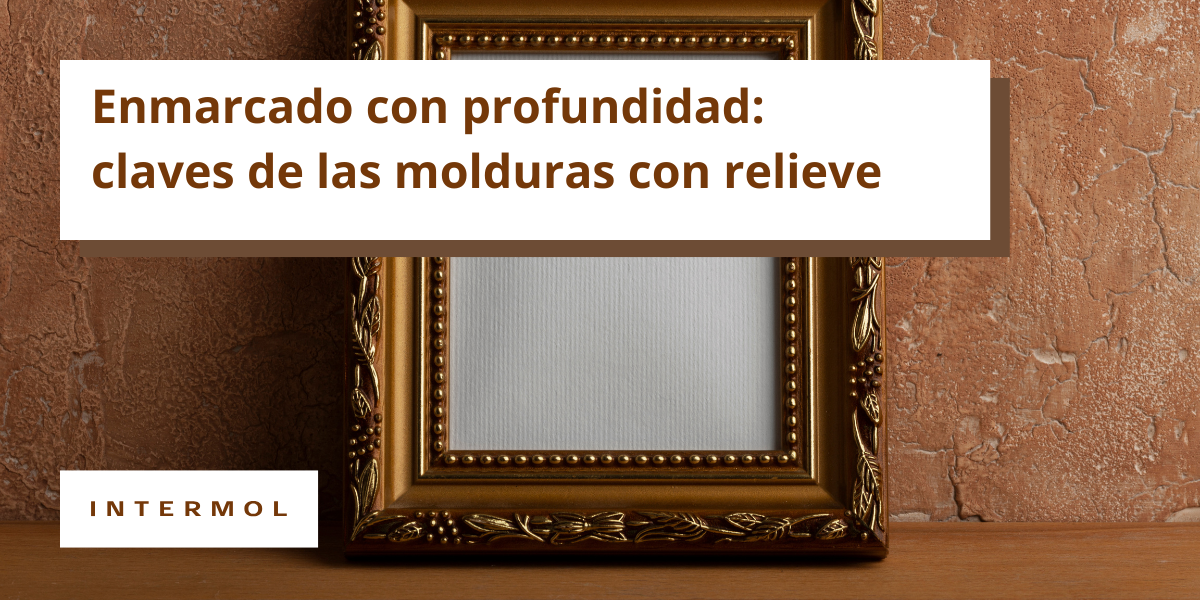
Relief mouldings: how they add texture and depth to framing
Relief picture mouldings represent one of the most effective solutions for adding visual character, aesthetic strength and a sense of volume capable of transforming any artwork. Their distinctive quality lies in their ability to integrate texture and three-dimensionality within the frame, creating depth in the framing that enhances the piece without overpowering it. This type of moulding has gained relevance both in professional framing contexts and in interior decoration, and its presence has become an essential resource for those seeking to give each artwork a distinct identity.
From a technical and visual perspective, relief mouldings offer a balance that combines structural protection, high-quality finishing and an artistic presence that enhances the value of what is framed. Their carved or engraved design allows light, shadow and volume to interact, adding dynamism and a level of visual appeal superior to that of smooth profiles.
What distinguishes a relief moulding
A relief moulding is not simply a decorated frame. It is a component designed with carved, engraved or layered elements that project beyond the usual plane. This relief generates a three-dimensional effect capable of enriching the final appearance of the framed artwork. When it comes to relief framing mouldings, the difference is immediately noticeable: the structure gains presence, texture and a more pronounced tactile and visual sensation.
These mouldings intensify the presence of the frame without overwhelming the artwork. A well-executed relief enhances the contrast between the plane of the artwork and the surrounding profile, separating the piece from its environment and drawing attention to the overall composition. In this way, the frame does more than protect: it becomes an active element within the decorative composition.
Why relief mouldings add depth to framing
Deep framing is a technique aimed at providing visual space to the artwork, offering a perception of greater openness and significance. Relief mouldings contribute directly to this effect for several reasons.
The first lies in their ability to create natural shadows. The carving introduces raised and recessed areas that interact with ambient light. This contrast adds dimension and turns the frame into a perceptible volume rather than a simple dividing line. This type of finish improves the visual reading of the artwork and creates a more immersive effect.
The second reason lies in texture, a key factor in aesthetic perception. Carved mouldings, engraved profiles or designs with subtle reliefs allow the frame to evolve from a simple accessory into an element with its own identity. Texture adds visual richness and, depending on its design, can convey classic elegance, artisanal character or structured modernity.
The third advantage lies in artistic coherence. Relief elevates the decorative level of the whole and allows for more natural integration with artworks of different styles. An ornamented frame can reinforce the sophistication of a painting with traditional motifs, while a geometric or linear relief is ideal for illustrations, prints or contemporary design pieces.
How to select relief mouldings for pictures
The selection of relief picture mouldings should take into account several criteria that combine technical aspects, aesthetics and coherence with the artwork. When reviewing a professional catalogue such as Intermol’s picture moulding range, it becomes clear that proper selection begins with analysing the material and the quality of the carving.
The relief must be clearly defined and integrated without irregularities. Wood, one of the most commonly used materials for mouldings, allows for precise carving while also providing structural stability. Choosing well-finished mouldings ensures that the relief not only decorates but also endures over time without deterioration.
Another important aspect is the profile. Tall mouldings with pronounced reliefs add presence and generate a stronger sense of depth. In contrast, softer reliefs provide understated elegance and are suitable for minimalist artworks or pieces that require a more restrained aesthetic.
The finish plays a crucial role in how the relief is perceived. Aged tones, matte or satin varnishes, bicolour combinations and decorative details cause each relief to be interpreted differently. Engraved mouldings in aged gold or aged silver, for example, create a highly attractive contrast, as the interplay between colour, shadow and sheen enhances three-dimensionality.
Intermol’s catalogue features clear examples of this type of moulding, such as the Moldura Pino 6993 Oro Envejecido Combinado Negro, made of finger-jointed pine wood and specifically designed for decorative framing. This moulding, available within the picture mouldings catalogue, combines engraved relief with an aged finish, creating a frame with its own character that intensifies the sense of depth.
Likewise, the aged silver version from the same range offers a cooler, more sophisticated style, ideal for modern artworks or interiors with neutral tones. Both models can be consulted in the Intermol mouldings section, where technical specifications and manufacturing details are provided.
Technical factors for achieving effective deep framing
Proper assembly is just as important as the quality of the moulding itself. For the relief to fulfil both its aesthetic and technical function, certain aspects must be taken into account during installation.
The first is centring the stretcher frame. A well-positioned artwork within the frame prevents the moulding from “eating up” visual space or creating unnecessary shadows on the image. When a mount is used, it must be carefully calibrated so that the relief does not interfere with its visual reading.
Lighting also influences how relief is perceived. Soft lateral lighting accentuates raised and recessed areas, while frontal lighting can reduce the sense of depth. In exhibition, domestic or commercial spaces, slightly angling the light source naturally enhances the perception of relief.
The third factor is coherence with the decorative environment. Relief mouldings require visual space around them to stand out. Placing them next to highly ornate elements can reduce their aesthetic impact, whereas a balanced environment allows the texture of the frame to be fully appreciated.
Aesthetic and professional advantages of relief mouldings
For professionals working in framing or interior decoration, relief mouldings provide decisive added value. Their presence turns a standard artwork into a standout piece. From a commercial perspective, their artisanal appearance and visual quality reinforce the perception of a premium product, directly influencing purchasing decisions.
These mouldings also make it possible to expand the range of services offered, differentiating basic framing from high-end solutions. Relief also offers a practical advantage: it ages well. Over time, the piece gains character, and subtle variations in light, use or exposure help to enhance the texture rather than conceal it.
Relief mouldings and interior design
Relief picture mouldings are not only part of the framing process: they are also decorative elements in their own right. The frame can become a focal point within the space, reinforcing the overall aesthetic. In classic interiors, ornamental reliefs integrate naturally; in contemporary spaces, linear or minimalist reliefs add sophistication and contrast.
The result is an aesthetic element that adds visual coherence, volume and texture to interior decoration. The frame ceases to be a simple boundary between artwork and wall, becoming an intermediate element that creates aesthetic continuity.
Add visual richness with relief framing mouldings
Relief picture mouldings are a key tool for achieving deep framing that enhances both the artwork and the space in which it is displayed. Their texture, volume and visual richness allow for more expressive compositions, while their technical properties provide protection and stability.
Exploring options within specialised catalogues such as Intermol’s makes it possible to find relief framing mouldings adapted to different styles and professional needs. Proper selection, installation and lighting ensure a final result capable of transforming any artwork into a focal point with presence and character.
In Same Category
- Molduras para espejos: tipos, acabados y trucos de instalación
- Cómo elegir molduras para vitrinas y marcos profundos
- Cómo elegir paspartú para cuadros que se colocarán en ambientes clásicos
- Molduras finas para cuadros: cuándo recomendarlas y cuándo evitarlas
- Cómo elegir molduras para cuadros en proyectos de interiorismo residencial