
Mountboard for framing: formats, uses and professional purchase
Mountboard for picture frames: the invisible key that transforms any framing
The mountboard, also known as passepartout, is much more than a simple accessory in the world of art and photography. Its presence defines the harmony between the artwork and its surroundings, protecting it while at the same time enhancing its aesthetic value. Although it often goes unnoticed, it is one of the most decisive elements when it comes to framing. Choosing it correctly directly influences how we perceive an image, an illustration, or a watercolour.
Mountboard is a key element in any professional framing process. From its protective function to its visual impact, selecting the right format, colour, and thickness can make a difference in the final finish. If you need to buy mountboard sheets for serial production or professional work, understanding its technical features is essential for an optimal result.
What is mountboard and why is it essential in framing
What is mountboard in a picture frame?
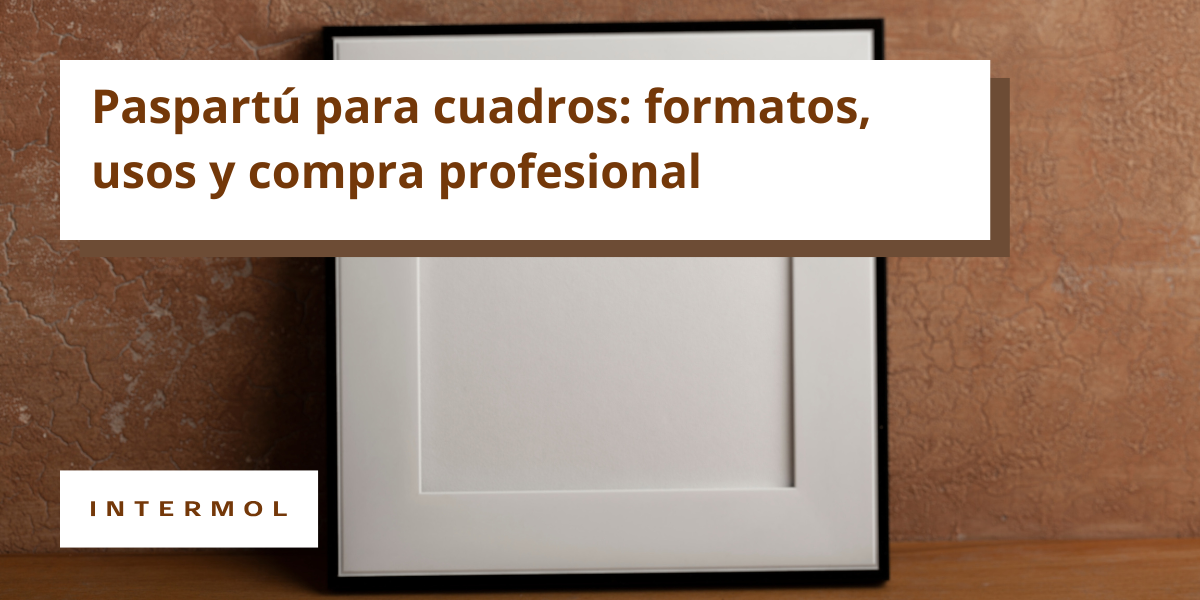
Mountboard is a rigid card or board with an opening in the centre, designed to surround an artwork or photograph, separating it from the frame’s glass. Its main function is to protect the piece from direct contact with the glass, preventing condensation or damage caused by pressure or humidity.
Benefits of using mountboard for frames
In addition to its preservation role, mountboard improves the presentation of the piece, creating a sense of depth. It is a visual resource that brings balance and elegance, especially in framed compositions. The choice of a good mountboard can enhance a work without the need for ornate frames.
What size should the mountboard be?
Recommended standard mountboard sizes
In the professional framing environment, the size of the mountboard sheet is chosen according to the artwork’s format and the type of mounting to be done. At Intermol we offer mountboard sheets in three main formats: 80x120 cm, 81.5x112 cm, and 112x163 cm. These sizes allow working with artworks of different dimensions, both in standard frames and in custom pieces.
How mountboard size influences the perception of the artwork
The size of the mountboard directly affects how the viewer interprets the whole. One that is too narrow may go unnoticed and fail in its aesthetic purpose, while one that is too wide may diminish the visual importance of the work. The key is to find a harmonious proportion between the piece, the mountboard, and the frame.
How to choose the right mountboard for each type of artwork
The ideal mountboard according to artistic style
Each piece has its own visual language, and the mountboard should act as a complement, not as the main feature. In classical works, warm tones create a sense of timelessness. In contemporary or minimalist art, white and black provide neutrality and strength.
Choosing mountboard for photography, watercolours, or illustrations
For black and white photography, neutral colours such as off-white or grey are most suitable. In colourful works, it is ideal to select a mountboard that harmonises with the predominant tones, without imitating them or creating an aggressive contrast. Chromatic balance is essential.
What mountboard thickness to use in each type of framing
Available thickness options for professionals
We offer mountboards in various thicknesses, from 1.4 mm to over 3.5 mm, allowing workshops to adapt the depth according to the type of mounting. Thickness also influences the three-dimensional perception of the whole, and is a key factor in achieving professional finishes.
When to use double-thickness mountboard
For exhibition projects or high-value artistic framing, double-thickness mountboard —or even a double layer of different colours— can provide a more professional appearance. This technique is common in portraits, prints, and limited editions.
How to store and handle mountboards without damaging them
Best conservation practices for mountboard sheets
Although sturdy, mountboard is a delicate material. Sheets should be kept completely flat, stored on horizontal surfaces, and protected from dust, humidity, and UV rays. Prolonged exposure can cause discolouration or warping.
Tips for cutting and assembling mountboards without mistakes
Work on clean surfaces, use sharp blades, and, whenever possible, wear gloves. This prevents grease marks and ensures a clean cut. Careful handling is essential for a professional finish, especially when working with custom mountboard frames.
Colour combinations in mountboard: keys to enhancing the work without stealing the spotlight
Neutral tones and their advantages in framing
Neutral colours are the most versatile choice. White, light grey, beige, or ivory easily adapt to most styles and do not compete visually with the artwork. They are perfect for photographic works or illustrations in soft tones.
Combining colours between mountboard, artwork, and frame
In certain cases, using coloured mountboard can highlight specific elements of the work. The key is to avoid letting this colour compete with the visual content. The whole should create a coherent narrative between the image, the frame, and the environment where it is displayed.
Why choose professional mountboard for your framing projects
In the professional framing world, mountboard is not just another accessory: it is an essential technical component. Our range of passepartout sheets is aimed exclusively at industry professionals: workshops, framing shops, picture manufacturers, and advertising agencies seeking flawless results and reliable materials.
At Intermol you will find a carefully selected range, with multiple colour, thickness, and format options, always with the quality required for professional work. We do not manufacture frames or pictures; we specialise in the materials that enable others to make them with excellence.
In Same Category
- Molduras para espejos: tipos, acabados y trucos de instalación
- Cómo elegir molduras para vitrinas y marcos profundos
- Cómo elegir paspartú para cuadros que se colocarán en ambientes clásicos
- Molduras finas para cuadros: cuándo recomendarlas y cuándo evitarlas
- Cómo elegir molduras para cuadros en proyectos de interiorismo residencial